

Artificial intelligence is only as good as the data it runs on. Models rely on massive streams of information, from structured enterprise databases to raw sensor outputs, and every byte must move, store, and transform efficiently.
Yet many organizations still struggle to keep their AI data pipelines from turning into tangled, expensive bottlenecks. Managing large data sets for AI isn’t just about capacity. It’s about strategy, architecture, and operational discipline that allows data to flow without friction.
Below is a detailed look at how organizations can take control of their large AI data environments, from collection and storage to governance and scaling.
Rethinking Data Infrastructure for AI Workloads
Traditional IT systems were never designed for AI-level data demands. Where a few terabytes once seemed vast, modern machine learning (ML) projects now easily surpass petabytes.
That requires infrastructure that scales both horizontally and vertically while maintaining speed and reliability.
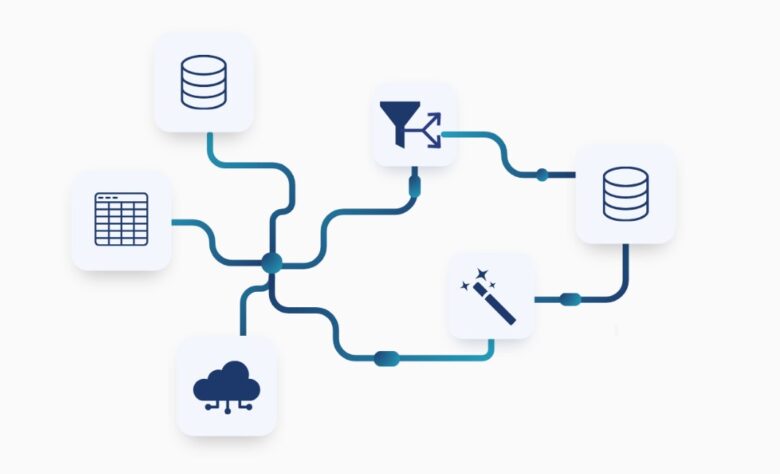
Modern systems like AI data transfer can simplify how organizations restructure their infrastructure for large-scale model workloads by reducing bottlenecks and improving real-time data flow.
Adopt a Distributed Data Architecture
Centralized storage creates bottlenecks. A distributed system, where storage and compute resources are spread across multiple nodes or regions, allows data to move and process in parallel. Popular approaches include:
- Data Lakehouses: Combine data lakes’ flexibility with the structure of warehouses. They can support unstructured AI training data while keeping metadata organized.
- Object Storage: Cloud-based object storage (like AWS S3 or Azure Blob) scales almost infinitely and supports tiered pricing based on access frequency.
- Hybrid Systems: Mix on-premise and cloud environments for sensitive workloads or regulatory compliance without giving up scalability.
Prioritize Bandwidth and Throughput
AI training consumes bandwidth faster than most networks can handle. Organizations often underestimate how data movement speed directly affects model iteration time. Solutions include:
- Deploying dedicated data pipelines between compute clusters.
- Using compression algorithms optimized for numeric data.
- Caching frequently accessed data close to the compute layer to reduce repeated transfers.

Data Quality as a Continuous Process
Quantity doesn’t equal quality. Training models on flawed data leads to poor predictions and bias propagation. A good data management strategy builds validation into every step of the pipeline.
Automate Validation at Ingestion
Before data enters your lake or warehouse, run automated checks for:
- Missing values
- Format inconsistencies
- Duplicate records
- Labeling errors
Machine learning models themselves can assist in anomaly detection by identifying patterns that deviate from established norms.
Maintain a Feedback Loop Between Models and Data Teams
When models begin showing drift, deviation from expected output accuracy, it’s often a symptom of deteriorating data quality. Monitoring performance metrics and connecting them back to data sources allows engineers to fix issues early rather than after costly retraining.
Managing Data Transfer at Scale
Once data sets grow into terabytes or petabytes, even small inefficiencies compound. Data movement becomes a logistical challenge, especially when distributed across multiple environments.
Batch vs. Stream Processing
- Batch processing: Best for large, periodic updates where data can be processed in chunks. Ideal for nightly or weekly model retraining.
- Stream processing: Essential for real-time applications like fraud detection or recommendation engines, where models continuously ingest fresh data.
Balancing both allows for agility without overloading the network.

Optimize Data Transfer Paths
- Use edge caching to process data closer to where it’s generated.
- Leverage APIs designed for high-throughput operations.
- Integrate data transfer orchestration tools to monitor performance, detect failures, and trigger retries automatically.
A well-structured transfer pipeline not only saves time but also ensures that models always work with the freshest data.
Strengthening Data Governance and Security
AI data often includes sensitive information, from personal identifiers to proprietary records. Strong governance ensures compliance, transparency, and ethical AI practices.
Centralize Access Control
Decentralized teams increase the risk of data sprawl. Adopting a centralized access management system with fine-grained permissions helps maintain accountability. Every data request, modification, or export should leave an auditable trail.
Encryption Everywhere
Encrypting data both in transit and at rest should be standard practice. Many organizations still rely solely on perimeter security, but that’s inadequate in distributed systems. Use encryption keys managed through secure vaults or hardware security modules.
Data Lineage Tracking
Data lineage tools map the entire path of each dataset, from source to model output, so teams can trace errors, comply with audit requests, and reproduce results when needed. This transparency builds organizational confidence in AI outcomes.
Streamlining Collaboration Between Data and AI Teams
Managing large AI data sets isn’t just a technical challenge. It’s also an organizational one. Many inefficiencies stem from miscommunication between departments or redundant data efforts.
Build Shared Data Platforms
Instead of siloed departmental databases, use unified data catalogs where all teams can find, tag, and request access to resources. Metadata tagging helps identify which datasets are suitable for model training, testing, or validation.
Encourage Version Control for Data
Versioning isn’t just for code. Data version control systems track changes, merges, and rollbacks across large datasets. That helps prevent confusion when multiple teams experiment with slightly different data slices.
Leveraging Automation and AI for Data Management
AI can also manage AI data. Machine learning models can optimize how data flows through the organization.
Intelligent Data Routing
Predictive systems can analyze workload patterns and pre-allocate storage or compute resources before a spike occurs. For example, if a model retraining session typically triggers a surge in I/O, the system can automatically provision additional throughput capacity in advance.
Automated Metadata Tagging
Machine learning can scan files, extract contextual details, and auto-tag them for easier retrieval. It’s particularly useful for unstructured content like video, audio, or medical imaging.
Predictive Maintenance for Data Infrastructure
Data infrastructure systems generate logs that reveal early signs of degradation. AI-powered monitoring tools can detect anomalies in disk usage, transfer speed, or failure rates and alert administrators before downtime occurs.

Key Metrics for Data Management Efficiency
Quantifying success ensures the strategy stays on track. While every organization has unique KPIs, some universal metrics include:
|
Metric |
What It Measures |
Why It Matters |
| Data Throughput | Volume processed per second or minute | Indicates transfer efficiency |
| Storage Utilization | Percentage of total capacity in use | Helps balance cost and expansion |
| Data Freshness | Time between data generation and model access | Reflects real-time capability |
| Error Rate | Frequency of failed transfers or corrupt files | Tracks system reliability |
| Query Latency | Time to retrieve data | Affects developer and model performance |
Regular audits against these indicators keep teams accountable and provide a clear path for continuous improvement.
The Road to Sustainable AI Data Operations
Managing large AI data sets effectively means aligning technology, governance, and culture. The most successful organizations treat data as a living system that evolves with their models, not a static resource to store and forget.
By combining scalable architecture, disciplined lifecycle management, rigorous governance, and automation, they transform data from a challenge into a competitive advantage.
Data isn’t just the fuel for AI; it’s the foundation for how intelligence grows within an organization. Managing it wisely ensures every model learns faster, performs better, and reflects reality more accurately.